Energy Minister Matola: ATMM Strategy Depends on Reliable Power Supply
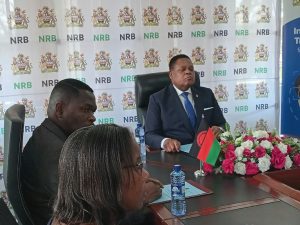
Minister of Energy Ibrahim Matola has emphasized that the success of Malawi’s Agriculture, Tourism, Mining, and Manufacturing (ATMM) strategy hinges on the availability of adequate and reliable energy across the country.
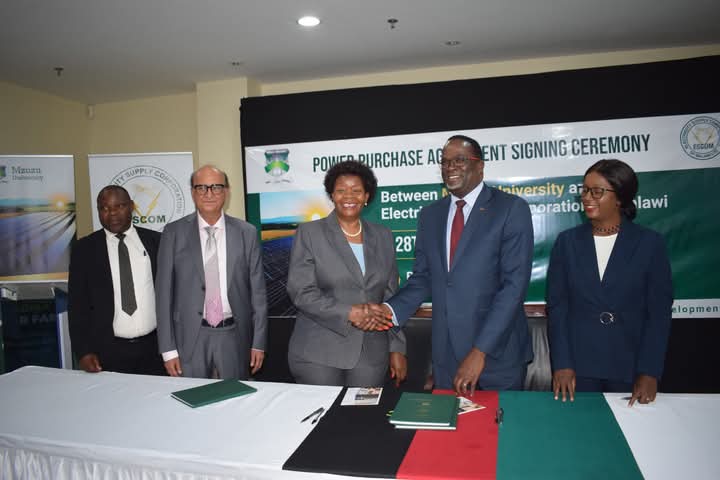
Matola made the remarks on Wednesday during a power purchase agreement signing ceremony between the Electricity Supply Corporation of Malawi (ESCOM) and Mzuzu University, held at the Bingu International Convention Centre (BICC) in Lilongwe.
Mzuzu University (Mzuni) has invested in a 20-megawatt solar power plant worth $20 million at Choma and has already signed a second deal to scale up to a 50-megawatt facility at a cost of €70 million. All generated power will be sold directly into ESCOM’s national grid.
Matola praised the initiative, stating that energy is the backbone of the ATMM strategy. “This signing ceremony marks a significant milestone in the energy sector,” he said. “To achieve our ATMM goals, we need stable and sufficient electricity to power industries in agriculture, tourism, mining, and manufacturing.”
He assured that the government will continue to provide a conducive environment for more investors to participate in the energy sector, calling it a key driver of economic transformation.
The minister noted that Malawi’s current installed electricity generation capacity is 554.24 megawatts—401.84 MW from hydro, 101 MW from solar, and 51.4 MW from diesel generators—with an additional 8 MW imported from Zambia and Mozambique.
“Mzuni’s initiative shows that universities can go beyond academics and provide real solutions to national challenges. Electricity demand is growing, and this kind of investment is a step in the right direction,” Matola said.
ESCOM CEO Kamkwamba Kumwenda highlighted the significance of the Mzuni solar project, especially for the northern region, which frequently experiences blackouts due to an outdated transmission line known as the Eastern Backbone.
“With Mzuni’s 20 megawatts coming in, this will be a game-changer for the north. Our infrastructure in that region is old and unreliable, so this project provides much-needed relief,” said Kumwenda.
He added that while the projected delivery date for the project is 2027, ESCOM has requested it be brought forward to 2026, citing the relatively faster construction timeline for solar energy projects compared to hydro.
Mzuzu University Vice Chancellor, Professor Wales Singini, said the solar project was initiated to give students hands-on experience in energy innovation. “We started with 5 megawatts, expanded to 20, and now we’re working toward 50 megawatts. This is not just theory; it’s a learning and development opportunity,” he explained.
Minister of Higher Education, Dr. Jessie Kabwila, lauded Mzuni for its visionary approach, urging other academic institutions to focus on problem-solving instead of simply criticizing policymakers.
In a related development, Nyika Hydropower Group also signed a Power Purchase Agreement with ESCOM for a 51-megawatt hydroelectric project. The company intends to feed this power into the national grid, further boosting supply in the north.
Nyika Hydropower Chairperson, Engineer Graeme Watson, said the project will create jobs and stabilize electricity in the region, where power generation has long been concentrated in the aging infrastructure of the southern region.
“Once operational, Nyika Hydropower will reduce blackouts and load shedding, supporting industrial growth in sectors like manufacturing and mining,” said Watson.
Malawi Energy Regulatory Authority (MERA) CEO Henry Kachaje commended both Mzuzu University and Nyika Hydropower for their forward-looking projects. He encouraged Mzuni to also explore wind energy, emphasizing the importance of diversifying beyond hydropower to meet future energy demands.